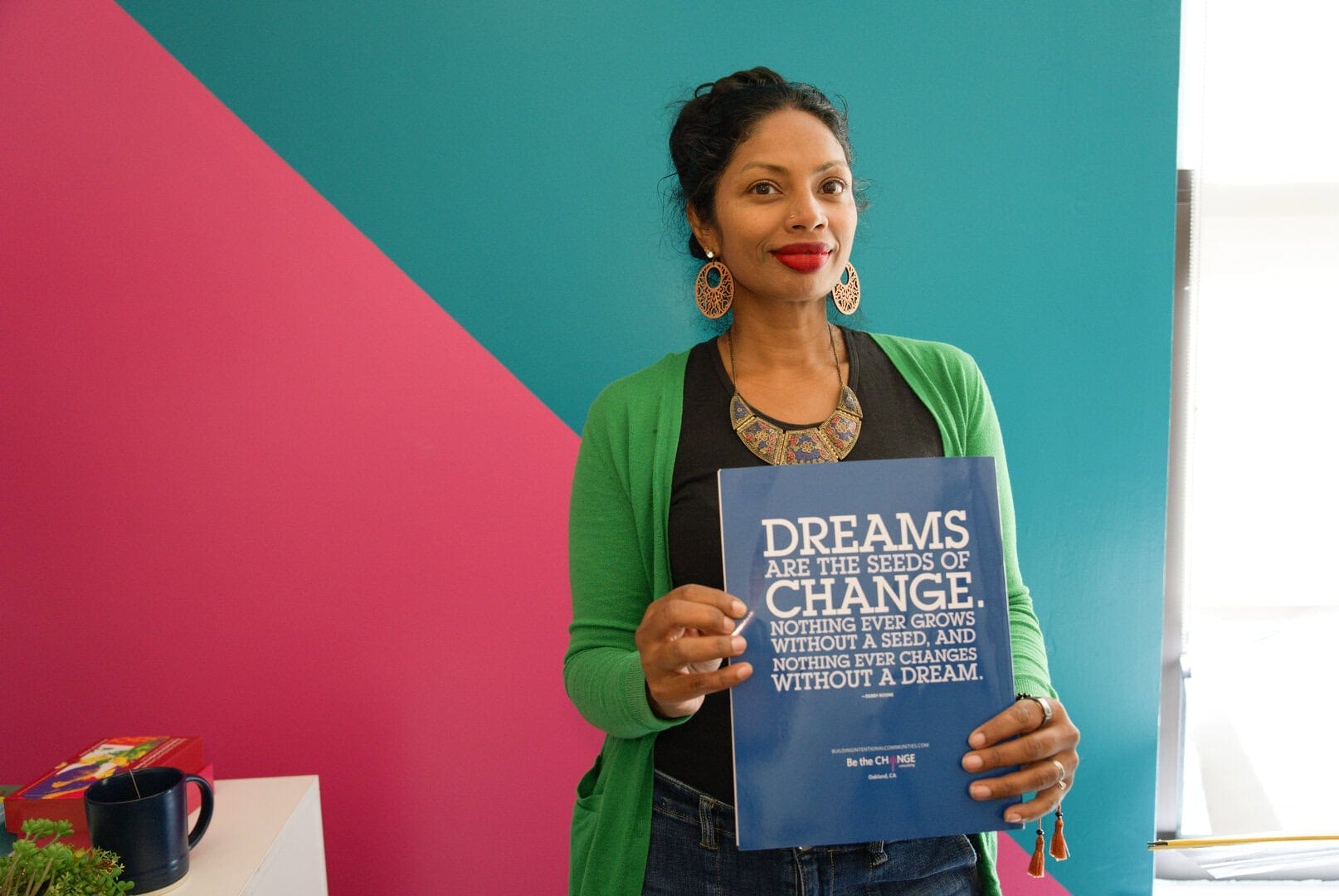
“Imagination thrives in community, not isolation.”
When I was just beginning my career, all I wanted was to contribute, be part of a team, do interesting work, and experience interesting things. I was entrepreneurial and eager for challenges, but I also longed for connections with colleagues who might share my values about how to move through the world.
I didn’t expect everyone to get along. I just knew that the more connections I felt, the easier it was to show up, especially when my newness meant I didn’t yet have expertise, relationships, or even the right words. But stepping into my first multigenerational, multiracial workplace was disorienting. After the relative freedom of college, I suddenly found myself in an environment ruled by unspoken norms about what you could talk about on breaks, when you were allowed to ask questions, and how to participate without being “too much” or “not enough.”
It was exhausting.
And I couldn’t yet name why.
When I founded Be the Change Consulting, I imagined spending my days working with people who could clearly see the gap between how things are and how things should be. It felt obvious to me that we needed to reimagine how we work together to achieve equity and impact.
But this year reminded me: vision alone isn’t enough.
Whether it’s shifting funding priorities or the collective stress of this moment, leaders are getting slingshotted back into dominant culture patterns, urgency, fear of open conflict, or either/or thinking. When we’re scared or overwhelmed, we collapse back into the familiar, even when the familiar is harmful.
Stories are powerful, but only when people know how to hold them.
Much of our work this year centered on elevating the truth that we are not all having the same experience at work. Storytelling, an Indigenous technology, helps bridge those gaps, entice imagination, and build community.
But during a recent session, something unexpected happened.
I invited participants to share stories about how their identities are supported or not supported in their workplaces. People opened up. They took risks. And yet the container for that vulnerability wasn’t held with the care it needed. Leadership didn’t meet the stories with appreciation, curiosity, or accountability.
EEKS! What was designed to deepen connection left half the group irritated and activated, and leadership was confused about why.
It was painful.
And my responsibility is to understand what happened.
What I learned was this: Stories are powerful but only when people know how to hold them.
I read nearly 200 raw, honest evaluation comments. They stung professionally and personally. I had to face the fact that I had led a group into an outcome that caused harm, especially to BIPOC staff. (Shout-out to my therapist and processing buddies for helping me go from spinning out to internalizing lessons #humility).
As I calmed down, those comments became the doorway into something deeper.
The Power of Radical Imagination
When I returned to the leadership team, we read some of the staff comments together. Unsurprisingly, it was hard for them to take it in, too. I heard comments like:
- “We do so much – What more do these staff expect from us?”
- “Do I have to be weak or cry for them to see me as human?”
- “We don’t have an organization to make staff comfortable – our work is to serve our mission and communities!”
These were difficult to hear €€and deeply familiar. I’ve asked versions of these questions myself. And this is the moment where radical imagination becomes essential.
To shift those 200+ comments from an attack on my skills, my dignity, and my professional ego, and instead make them tiny lights illuminating a path away from the familiar and toward something collective—I had to transform how I understood them.
Here is a framework that supported that shift
| When I hear staff say… | I tend to feel/think… | A Radical Imagination Question I can ask myself… |
| “I don’t feel supported.” | I’m doing my best—why don’t they see that? | What support do they need that I’ve never been taught to give? |
| “I don’t feel safe speaking up.” | Why are they so sensitive? That activity felt fine to me! | What would safety look like if I weren’t the one defining it? What comforts do I experience that they may not? |
| “Leadership isn’t listening.” | We are listening—they just don’t like the answers. | What are they asking me to hear and understand when they speak? Is something being communicated that I’m not picking up? |
| “Nothing ever changes.” | We’ve changed so many things! They don’t understand our constraints. | Have I shifted anything they actually cared about? Have I communicated my sense of the constraints? Are these constraints actually fixed—or am I assuming that? |
| “I feel invisible.” “I don’t feel seen.” | But we treat everyone the same! | What identities or experiences am I unconsciously overlooking? What does this person want to be seen for? Who do I see? |
| “I don’t trust leadership.” | That’s unfair—we’re trying. | What behavior from me today would build trust tomorrow? |
This process is not about blame. It’s about expanding possibilities.
From here, I invited the leadership team to imagine:
“It’s six months from now. We’re repeating this exercise. What do you want the comments from both staff and leadership to sound like?”
The responses were powerful:
| From Staff | From Leadership |
| “I can see that people are having experiences at work that are different from mine.”“My experience was met with curiosity and compassion—not extraction.”“I learned something new about the humanity and pressures of those in leadership.”It feels good to share parts of myself that matter to me, but don’t have time/space for in our regular working spaces.” | “I now recognize the tiny ‘paper cuts’ we give each other in everyday communication—and I can shift my own language.”“I commend these folks for expecting something from their leaders that I never even thought to want from mine.”“I’ve been socialized to not need these things—but maybe it’s not bad that others get more than I did.”“I’ve never seen this model for me—and that’s why I don’t know how to do it.”“Staff are asking for something I did not know was possible. Maybe they deserve this… and so do I.”“Our culture doesn’t yet support this openness—but I want to build toward it.”“I think I understand what you want. I don’t yet know how to do it.”“I don’t know how to lead us there, but I’m willing to be led by you. How do we create that together?” |
Why Imagination Matters More in Times of Constraint
Dominant culture tells us that when times are hard, we should narrow our scope, cling to efficiency, and regress to old norms.
But those norms are already failing us.
They’ve been failing many of us for a long time.
2025 can teach us something new—if we let it:
- The old ways aren’t working.
- They never worked for many of us.
- The fractures in our systems aren’t flaws—they’re portals.
This is the moment to redesign, reimagine, and listen to one another with renewed intentionality.
We’re Launching Affinity Spaces in Our 2026 Public Training Series
If this year has taught me anything, it’s this:
- We cannot transform our organizations alone.
- We need practice.
- We need a connection.
- We need rooms where belonging is the baseline—not the aspiration.
That’s why our 2026 Public Training Series will include Affinity Spaces, where participants can:
- Sit in racial affinity with others who are curious, courageous, and growth-oriented.
- Explore how our socialization shapes our relationship to dominant cultural practices.
- Practice telling the truth, hearing the truth, and staying with discomfort without collapsing into judgment.
- Listen to stories and reflections across racial identity groups.
- Co-create empathy-centered micro-practices that can shift workplace culture.
- Imagine the inclusive, liberatory future our organizations deserve.
Join us.
Your leadership and our collective future depend on it.
In Solidarity,
Sangita